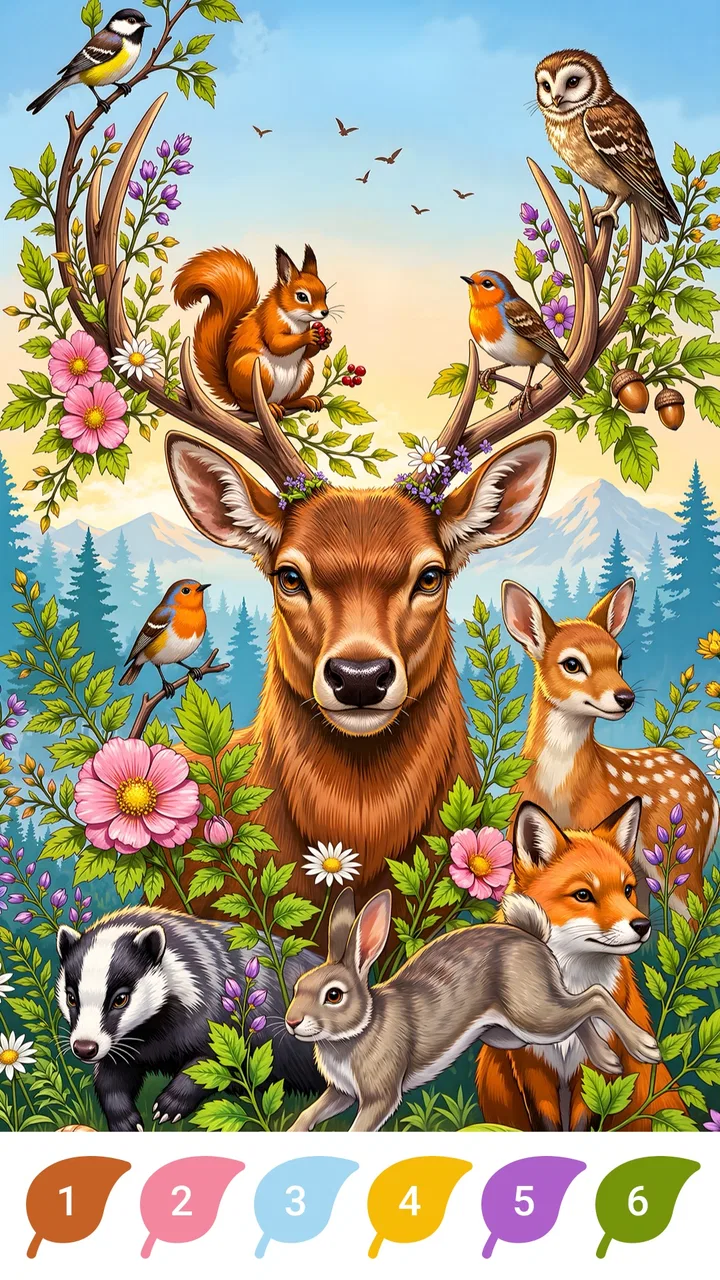
Magical Forest Color by Number
- 4.7
- Rating
- 50.00K
- Installs
- Free
- Price

 Analysis by App-foxy
I opened Magical Forest Color by Number expecting a quiet board game for short breaks, and that is exactly where it fits best. It turns coloring into a gentle, number-guided activity built around woodland scenes, cabins, and animals. The idea is simple enough to understand immediately, but the real question is whether that simplicity can keep me interested after the first few pictures. My answer is cautiously positive: it works well as a relaxing routine, especially when I want something calmer than a competitive puzzle, although players looking for deep strategy or a demanding challenge may find it too limited.
Developed by Joyarc Coloring Games, this free game sits in the board category and is suitable for Everyone. It has reached over 50 thousand installs and holds a 4.7 average from more than 500 ratings, which suggests that its peaceful approach has found an audience. The current release is version 1.0.9, and it runs on Android 7.0 or later. Those details make it accessible to people using older phones, while the free entry point makes trying it fairly easy. Optional purchases range from under a dollar to around forty dollars per item, so I would pay attention to any purchase prompts if I were handing the phone to a child.
How the first few coloring sessions create a sense of progress
The opening appeal comes from having an immediate goal that requires no explanation: choose a picture, identify the numbered areas, and fill them in. I do not need to learn a complicated rule set or understand a story before starting. That low barrier matters because the game is aimed more at unwinding than at testing my ability to plan several moves ahead.
You May Also Like

 Blood Strike: 2.5 Anniversary
Blood Strike’s Loadouts Turn Every Drop Into a Tactical Gamble
A close look at Blood Strike’s custom loadouts: how fast access to signature weapons reshapes its battle royale rhythm, rewards preparation, and narrows the gap between fights.

 Pandora - Music & Podcasts
Pandora’s Music Is Easy to Start, but Harder to Recover
Pandora’s strength is its low-effort path from a seed to a station. Its weak spot is how much confidence it asks you to place in connection, setup, and quiet recovery.

 8 Ball Pool
 Is Built on Rivalries, Rematches, and Routine
A close look at the rivalries, rematches, shared routines, and unanswered safety questions that turn a quick pool match into a persistent mobile community.

 Samsung Music
’s Quiet Strength Is Playing What You Already Own
Its reach comes less from spectacle than from dependable access to a personal library. That simplicity is both the app’s strongest retention engine and its ceiling.

 AccuWeather: Weather Radar
AccuWeather Review: A Quick, Clear Forecast for Everyday Decisions
For everyday plans, the best forecast is the one you can understand quickly. AccuWeather makes rain timing, radar, and local conditions easy to act on, with a few trade-offs.

 Hill Climb Racing
Why Hill Climb Racing Still Turns Crashes Into One More Run
A tiny car, a bumpy hill and one more upgrade: Hill Climb Racing keeps resurfacing because its simple chaos makes every near-miss feel personal.
More From Our News Desk
View All News


The forest theme also gives the early sessions a clear identity. A cabin feels different from an animal, even when the basic coloring action remains familiar. I found that useful because the visual subject gives each page a small reason to continue. I am not simply completing anonymous shapes; I am gradually bringing a woodland image into view.
The first practical goal is completion itself. That sounds modest, but it suits the format. A short session can begin with the intention of finishing one area, while a longer session can continue until the whole illustration feels complete. This makes the game easy to fit around ordinary routines. I can imagine using it while waiting for an appointment, during a quiet evening, or after work when a more demanding game would feel like effort.
What it does not offer, at least in the way I experienced it, is a strong strategic objective beyond finishing the artwork. There is no reason to optimize a move order or protect a limited resource. That is not a flaw for the intended relaxing audience, but it is important to understand before downloading. The early goal is creative completion, not tactical mastery.
Small progress signals work better than dramatic rewards
The most satisfying signal is visual. Every correctly colored section makes the image look more finished, and that change is easier to appreciate than a purely numerical score. For me, this is the kind of feedback that supports a calm mood: progress is visible without turning the session into a race.
There is also a useful psychological rhythm in moving from scattered blank spaces toward a coherent scene. I tend to notice the broad shapes first, then the smaller details. That gives me natural stopping points. If I only have a few minutes, I can work on an obvious section; if I have more time, I can keep going until the picture has its final balance.
One tip I would give new players is to avoid treating every unfinished area as an obligation. The game is more pleasant when I use the next available color or the most appealing part of the image as my guide. Chasing total completion too aggressively can make a relaxing activity feel like a checklist. The artwork itself is the progress indicator, so there is little benefit in creating pressure where the game does not require it.
This visual progression is also why the title is more approachable than many traditional board games. In a conventional board game, progress may depend on remembering rules, reading an opponent, or calculating consequences. Here, the player can understand the state of the picture at a glance. That makes it a better fit for casual players, younger users, and anyone who wants a low-stakes activity.
The difficulty curve stays gentle, and that is both its strength and its limit
Number coloring usually asks for attention rather than advanced reasoning, and this game follows that expectation. The challenge comes from locating the right spaces and keeping track of the color-number relationship. I found that the task can become more absorbing as a picture fills in, but it does not transform into a demanding puzzle with a sharply rising skill ceiling.
That gentle curve is valuable when I am tired. I can make progress without feeling punished for a mistake or forced to restart. It also makes the game suitable for players who dislike timers and competitive pressure. Someone looking for a peaceful digital coloring book will probably appreciate that the activity does not constantly interrupt the mood with high-stakes decisions.
The trade-off is that experienced puzzle players may reach the limits of the challenge quickly. If your ideal board game involves bluffing, resource management, or several possible strategies, this will feel more like a coloring pastime than a traditional game. I would choose a strategy board game instead when I want to think hard, compete with another person, or feel that every move changes the outcome.
A practical way to get more value from the difficulty curve is to alternate between detail and momentum. I like completing a few easy-looking regions first, because the picture becomes recognizable sooner. After that, the smaller sections feel less tedious because I can see how they contribute to the finished scene. This is not a new game mode; it is simply a better personal workflow for keeping the activity comfortable.
The woodland setting supports that pacing. Natural subjects tend to be forgiving visually: leaves, fur, trees, and cabins can feel pleasant even when I am not trying to produce an artistic masterpiece. The theme is therefore more than decoration. It tells me what emotional pace to expect, and it makes the game easier to return to when I want quiet rather than excitement.
What keeps a session going, and where retention can become pressure
The main reason I continued from one image to the next was the desire to see another scene completed. That is a modest but effective retention loop. The player begins with an unfinished illustration, makes steady progress, and receives the satisfaction of a finished result. For a coloring game, that can be enough, particularly when the images provide variety through forest life and cozy buildings.
Still, the long-term pull depends heavily on whether the available artwork continues to feel fresh to the individual player. If I enjoy enchanted woodland imagery, the theme gives the collection a consistent personality. If I prefer abstract designs, city scenes, or highly intricate mandalas, the focus may feel narrow. The game is strongest when its subject matter matches the player’s taste rather than trying to serve every possible coloring preference.
Because it is free, the optional purchase range is worth considering as part of the retention experience. A free download lowers the risk of trying it, but repeated purchase prompts can change the feeling from relaxing to commercial if they appear too often. I would recommend deciding in advance whether this is a no-spend pastime or whether paid content is acceptable, especially on a shared family device. The game’s Everyone rating makes it broadly approachable, but age suitability does not automatically mean every purchase flow will suit every household.
I also would not confuse a large install count with a guarantee that the game will match my personal expectations. Its audience size indicates that the concept is accessible, while the rating shows strong general approval, but neither tells me whether I will enjoy the exact pace. My own test is simple: after completing an image, do I want another one because the process felt soothing, or only because I am chasing an external reward? If the answer is the latter, this may not hold attention for long.
For an everyday scenario, I can see this working well during a short evening reset. I might sit down after dinner, complete a few sections of a cabin illustration, and stop before the activity becomes tiring. The lack of competitive urgency means I can leave without feeling that I have abandoned a match. That is a meaningful advantage over many board-style games, where stopping halfway through can be inconvenient or where a loss can leave me more frustrated than relaxed.
Who will enjoy it, and who should choose something else
I would recommend it to people who like digital coloring, gentle visual tasks, and short sessions with a clear beginning and end. It is particularly suitable for anyone who wants a calm alternative to action games or social competition. Families may also appreciate the approachable theme and Everyone age rating, although I would still supervise purchases rather than assuming that free installation means every part of the experience is free.
It can also work for players who have not traditionally considered themselves gamers. The controls and objective are easy to grasp, and the board-game classification does not mean I need to understand a complex tabletop ruleset. A parent, grandparent, or casual phone user can pick it up without first studying a tutorial-heavy system.
I would skip it if I need multiplayer interaction, a story with character development, or a strong sense of mastery. It is not the right replacement for a competitive board game with friends, a logic title built around increasingly difficult problems, or an art tool where I can draw freely from an empty canvas. Its appeal comes from guided completion, not unlimited creative control.
That distinction is important. In a free-form drawing app, I decide what to create, but I also face the pressure of making something from nothing. Here, the image provides the structure, so I can focus on the repetitive pleasure of finishing it. Players who find that structure comforting will likely see it as a benefit. Players who want artistic ownership may find the numbered areas restrictive.
My verdict on goals, pacing, and staying power
Magical Forest Color by Number succeeds because its goals are honest and easy to read. I color a woodland picture, watch it become complete, and decide whether I want to begin another. The progress is visual, the difficulty remains approachable, and the theme gives the experience a warm identity. It does not need elaborate systems to be useful during a quiet break.
Its limitations are equally clear. The challenge is gentle rather than strategic, and long-term interest will depend on how much I enjoy returning to the same general forest atmosphere. Optional purchases also mean that I should approach the free download with sensible expectations and keep an eye on spending controls. Those points do not undermine the concept, but they do determine who will get the most from it.
For me, the best way to play is in small, pressure-free sessions: choose one scene, work through the areas that look inviting, and stop when the activity stops feeling restful. I would not use it as my main board game, but I would keep it available for the moments when I want a simple visual task instead of another demanding screen experience. If your ideal game is a peaceful path from blank spaces to a finished forest scene, this is an easy recommendation; if you need deep strategy or constant novelty, look elsewhere.
FAQs for Magical Forest Color by Number
01What is Magical Forest Color by Number?
Magical Forest Color by Number is a relaxing coloring app centered on enchanted woodland scenes, fantasy creatures, flowers, and other nature-inspired illustrations. Instead of choosing colors freely, you fill numbered sections with the matching shades. The straightforward format makes it suitable for casual players who want a calming activity, while the magical artwork gives the app more personality than a basic coloring book.
02How does the coloring system work in Magical Forest Color by Number?
Each picture is divided into small numbered areas, and the color palette shows the shade associated with each number. You select a color and tap the matching sections to complete the image. The app is generally easy to understand, although very detailed drawings may require careful zooming. Helpful highlighting or guidance features can make it easier to locate remaining areas when a picture is nearly finished.
03Is Magical Forest Color by Number free to download and play?
The app can generally be downloaded without an upfront purchase, but free access may include advertising, optional purchases, or limitations on certain pictures and features. Availability can vary depending on the Android or iOS version and the developer’s current monetization model. Before downloading, it is worth checking the store listing for subscription details, in-app purchase prices, and whether premium artwork is locked.
04Does Magical Forest Color by Number work offline?
Some previously available coloring pages may be usable without a continuous internet connection, which is convenient for travel or areas with weak service. However, the app may still need internet access to download new artwork, display advertisements, synchronize progress, or validate purchases. Offline behavior can differ between devices and app versions, so users should open desired pictures while connected before relying on the game without Wi-Fi or mobile data.
05Who will enjoy Magical Forest Color by Number?
Magical Forest Color by Number is best suited to people who enjoy gentle, low-pressure games and fantasy-themed artwork. It can appeal to children, teenagers, and adults, although younger users may need supervision if advertisements, purchases, or external links are present. Players looking for competitive challenges or complex gameplay may find it too simple, but anyone wanting a quiet way to pass time and create colorful images should find it approachable.
Pros
- Calming activity suitable for short
- relaxing breaks
- Simple tap-to-color controls are easy for beginners
- Works well for users who enjoy nature and fantasy artwork
- Progress is easy to follow across unfinished coloring pages
- Color palettes help create appealing results without drawing skills
Cons
- Some detailed pictures may take considerable time to complete
- Repeated tapping can become tiring on larger illustrations
- The fantasy theme may feel limited for users seeking varied subjects
- Finished images may offer little value beyond casual entertainment
- A larger screen provides a more comfortable coloring experience

Magical Forest Color by Number
Gallery